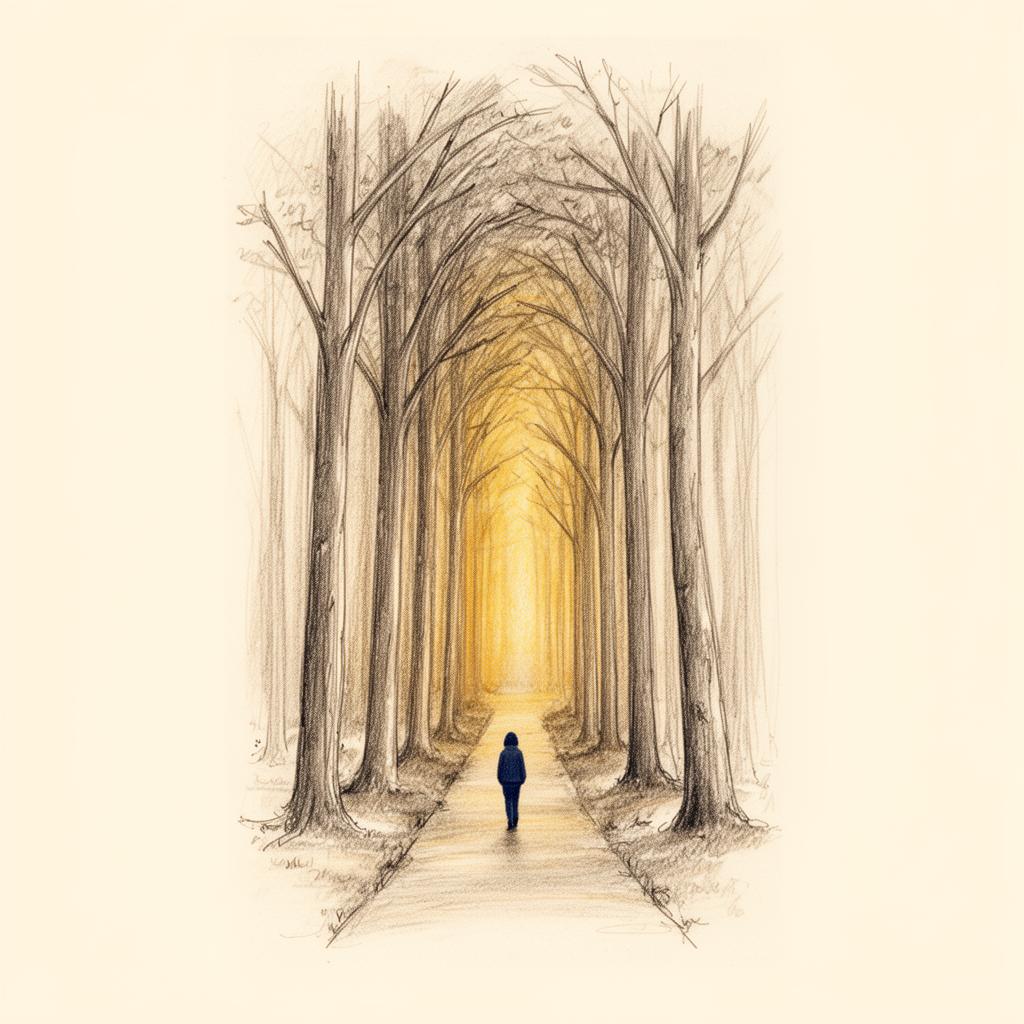
Into the forest
On withdrawal, and why it has always come before change.
Before almost every turning point in the history of human thought, someone went away. This paper traces the practice of withdrawal across unrelated traditions, from the forests of India to the deserts of Egypt and the caves of Arabia, and shows that they arrived independently at the same shape and often at the same measure of it. Drawing on van Gennep, Turner and Campbell, it argues that the retreat is a stable three-part structure of separation, liminal middle and return, and that the four energies of the yogic tradition give it four legitimate forms. It closes with a reading of what the modern world has done to the practice, and what it would take to recover.
Why this paper
A note on what brought this writing into being
The first working paper made the case that the spiritual life has a structure, and that a person can be matched to the form of practice that fits their nature. This second paper sits one step earlier in the seeker's journey. Before the question of which path, there is the older and simpler question of whether to go at all.
I came to this question by way of my own withdrawals. Time in ashrams, time in silence, time alone in places where I knew almost no one. What I noticed, and what I think the traditions noticed long before me, is that the act of stepping away is itself the practice. The teacher you meet, the lineage you sit with, the form you take up, all matter. But the leaving is what makes any of them possible.
The retreat is one of the oldest practices the human being has for changing, and it still works.
What this paper does
It follows withdrawal across cultures that never spoke to one another and shows the same shape appearing each time. It looks at why the structure does what it does. It names what has been lost in the modern arrangement of a life, and what remains recoverable. It ends with the work EasyDharma has set itself, which is to make the recovery practical for an ordinary person with an ordinary life.
How to read it
As an invitation more than an argument. The figures and the references are here for those who want them. The heart of the paper is in the sections themselves, which are written to be read slowly. The reading itself is a small withdrawal.
Before the turning, the leaving
The Buddha left a palace and sat beneath a tree. Muhammad climbed to a cave above Mecca. Moses went up a mountain and stayed forty days. Twenty-three centuries later, Carl Jung built a small stone tower on the shore of a lake, with no electricity and no running water, and went there to chop his own wood and be alone. He wrote that at the tower he was "most deeply myself."
These people did not know each other. They lived in different centuries, spoke different languages, and prayed, if they prayed at all, to different things. Yet each of them arrived at the same instruction. If you wish to become someone you are not yet, first step away from everyone you already are.
We tend to read this as a story about exceptional people. It is better read as a story about a method. The withdrawal came before the insight, case after case, which suggests the withdrawal was not incidental to the insight. It was its condition.
Somewhere in the last century we lost this. Stepping away became a holiday, a reward for work rather than the work itself. This paper is an attempt to recover the older understanding. The retreat is one of the oldest practices the human being has for changing, and it still works.
If you wish to become someone you are not yet, first step away from everyone you already are.
India gave the practice a name and a place
India gave the practice a name and a place in the order of a life.
In the classical scheme of the four ashramas, a life moved through four seasons: the student, the householder, the forest dweller, and the renunciate. The third of these, vanaprastha, translates as the way of the forest. After the years of family and work, a person was expected to loosen their grip on possessions and position and turn toward the forest and toward contemplation. Withdrawal was not a crisis to be managed. It was a stage of growing up, built into the architecture of an ordinary life.
The literature followed the people. The Aranyakas, the texts that sit between the ritual manuals and the Upanishads, take their name from aranya, the forest. They were composed by and for those who had gone to the woods to think. The most searching philosophy India produced was, quite literally, forest writing.
The pattern repeats in its founders. The Buddha spent years in the forests by the river before the night under the Bodhi tree at which he is said to have woken. In the twentieth century the sage Ramana Maharshi arrived at the hill of Arunachala as a boy of sixteen and did not leave it again, living for years in near silence in a cave on its slope. The setting changes a little. The forest, the riverbank, the cave. The movement does not. A person goes apart, and something in them ripens that could not ripen in company.
The same shape, found apart
What is striking is that India was not alone, and that the others did not copy.
In the deserts of Egypt, in the third and fourth centuries, men and women walked away from the towns to live as hermits. Anthony of Egypt, remembered as the father of Christian monasticism, gave away what he owned and went deeper into the desert to be alone. So many followed him that his biographer wrote the desert had become a city. Centuries later a wounded Basque soldier named Ignatius spent the better part of a year near the town of Manresa, much of it in a cave, and came out with the Spiritual Exercises, a retreat of thirty silent days that is still made today.
Islam begins with a withdrawal. Before the first revelation, Muhammad would go alone to a cave called Hira on a mountain outside Mecca and stay there for days at a time. The Sufis who came after him built the practice into a discipline they called khalwa, the seclusion, whose classic length is forty days.
That number keeps returning. Moses on the mountain for forty days. The people in the wilderness for forty years. Elijah walking forty days to a cave, where he found that the divine was not in the wind or the earthquake or the fire, but in a small, quiet voice. Jesus forty days in the desert before he began to teach. The traditions did not share notes. They arrived separately at the same shape, and at strangely similar measures of it. When unrelated people keep discovering the same thing, it is usually because the thing is real.
Unconnected traditions arrived at the same settings for withdrawal, and often at the same measure of it: forty days.
I went to the woods because I wished to live deliberately, to front only the essential facts of life.
Henry David Thoreau, Walden (1854)The three movements of a retreat
A century ago an ethnographer named Arnold van Gennep noticed that the ceremonies marking the great passages of a life, birth, adulthood, marriage, death, were built the same way the world over. First a separation, in which the person is removed from their familiar place. Then a middle state, threshold and uncertain, in which they are no longer who they were and not yet who they will be. Then a return, in which they come back and are received as someone new. The anthropologist Victor Turner gave that middle state a name that has stuck, the liminal, from the Latin for threshold. Later the scholar of myth Joseph Campbell found the same three beats beneath the world's hero stories. Departure, initiation, return.
A retreat is this structure, made small enough to enter on purpose. You leave. You spend time in the unfamiliar middle. You come back changed. Each part is doing work.
After van Gennep (1909), Turner on liminality, and Campbell on the hero's journey.
The leaving matters because the self is held in place by its surroundings, the roles, the schedule, the people who expect you to be who you were yesterday. Remove the scaffolding and the self becomes briefly soft, and what is soft can be reshaped.
The middle matters because it takes time, and this is the part the modern world finds hardest to accept. The traditions did not speak of forty minutes or a free weekend. They spoke of forty days, three months, three years. There is good reason to think they were right. Chosen solitude is not the same as loneliness, and the mind treats them differently. Krishnamurti kept that distinction in plain words. Loneliness is the ache of being cut off from others. Aloneness is something else, uncrowded and entire, which he was willing to call a benediction. Left undirected in that aloneness, the mind turns inward, sorts, connects, and arrives at thoughts it cannot reach while busy. Time among trees and open ground restores an attention that crowded places wear down. None of this is fast.
The return matters because a retreat that does not come home is only an escape. The point was never to leave. The point was to leave, and then to bring something back.
Four energies, four kinds of retreat
If the structure is universal, the form is not. And here EasyDharma has something of its own to add.
The traditions that discovered retreat discovered it along different lines of human energy. Some withdrew to love. The devotional retreat is full of song, image, and surrender, the heart turned toward something larger than itself. Some withdrew to understand. The contemplative retreat is silent and bare, given to inquiry and the patient watching of one's own mind, as Ramana watched his on the hill. Some withdrew to serve. The retreat of work and community asks the seeker to lose themselves in the labour of a shared life, the field, the kitchen, the care of others. And some withdrew to practise. The disciplined retreat is a system of posture, breath, and meditation, repeated until it changes the one who repeats it.
These are the four energies that run through the yogic traditions. They are not better or worse than one another. They are different doors into the same room, and a person tends to have one that opens more easily for them.
This is the quiet error in most modern retreats. They offer a single form and assume it fits everyone. A seeker drawn to devotion is sent to sit in silent inquiry, finds it cold, and concludes that retreat is not for them. The truth is closer to this. The retreat that transforms a person is the one that meets their nature rather than fighting it. The first question is not where to go. It is which kind of seeker you are.
The forest stage is gone
The forest stage is gone. Almost no one alive expects, at a certain age, to hand over their work and turn toward contemplation. The architecture that once guaranteed a season of withdrawal has quietly fallen out of use, and nothing has replaced it.
In its place is a life with no edges. The day no longer ends. A person reaches for a phone within minutes of waking and well over a hundred times before sleeping. Solitude, once unavoidable, has become something a person must defend, and most of us have lost the habit of it.
It was not always so, even recently. Gandhi, in the years he was leading a nation's movement, kept one day of every week in complete silence, communicating only by written note, and held to it even before important visitors. He thought silence part of the discipline of anyone seeking truth. He was busier than we are, and he guarded it.
Meanwhile the word retreat has been kept and its meaning thinned. It now often names a holiday with better lighting. The wellness industry has learned to sell the appearance of withdrawal, the calm setting and the soft schedule, without the substance that made withdrawal change people.
Global wellness tourism spending, in US dollars. The form of retreat has become an industry. The depth has not kept pace. Source: Global Wellness Institute.
There is nothing wrong with rest. But rest is not transformation, and a person who came for the second and was sold the first goes home unchanged, and quietly concludes the old promise was never true.
It was true. It is still true. It has only become harder to find.
What is missing is the path to the practice
None of what the traditions knew has been lost. It has only been scattered, and made difficult to reach. The structure still works. The separation still softens the self. The liminal middle still does its slow work. The return still brings something home. What is missing is not the practice but the path to it, a way for an ordinary person, with a life they cannot simply abandon, to step into a real retreat and to be met by the right one.
That is the work EasyDharma has set itself. Not to invent a new kind of retreat, which would be arrogance, and not to improve on traditions that have done this for thousands of years, which would be folly. The form belongs to the spaces that have kept it. What we add is the layer around it. The preparation that helps a seeker arrive ready. The matching that sends them toward the form their nature can use. The presence that supports them while they are away. And the integration that helps them carry the change back into the life they returned to.
The forest is still there. Our work is to help you find your way to it.
The personal retreat is not a holiday from your life. In the oldest and most reliable understanding we have, it is one of the few things that has ever dependably changed a life. You go in alone. You stay long enough for something to move. You come back, and you are not quite the person who left.